
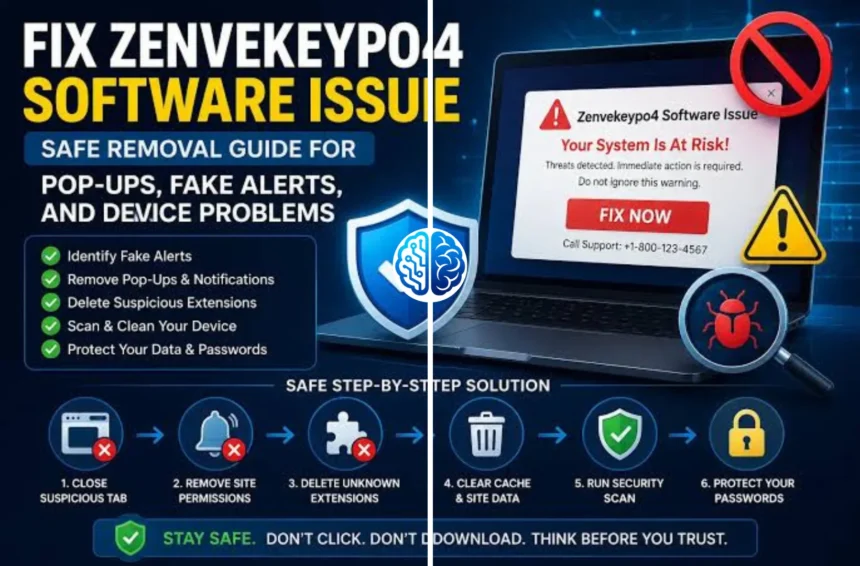
The phrase “Zenvekeypo4 software problem” has recently started appearing in online searches, troubleshooting articles, and technology-related discussions. A person encountering the term may naturally assume that Zenvekeypo4 is an established computer program, a system component, or a recognised error affecting Windows, Android, or another operating system.
However, the available evidence presents a very different picture.
There is currently no clearly verified public software product called Zenvekeypo4. No identifiable developer, official product website, established support centre, recognised app-store listing, or reliable technical documentation can be connected confidently to that exact name.
Some websites describe Zenvekeypo4 as productivity software. Others connect it with encryption, password management, automation, battery systems, installation failures, or general computer errors. The conflicting descriptions make it impossible to treat these claims as confirmed product information.
For users, the safest approach is not to assume that every unfamiliar technical phrase represents a genuine application. The term may be a spelling mistake, an internal filename, a browser notification, an invented keyword, or a misleading warning designed to encourage unnecessary downloads.
This guide explains what the Zenvekeypo4 software problem may mean, why it appears online, its possible causes, the risks involved, and the safest steps users can take.
Quick Facts Table
| Field | Verified information |
|---|---|
| Name | Zenvekeypo4 software |
| Topic | Zenvekeypo4 software problem |
| Type | Unverified software-related term |
| Official status | Not confirmed as an established public product |
| Developer | No verified developer identified |
| Official website | No authoritative official website confirmed |
| Release date | Not publicly verified |
| Latest version | Unknown |
| Supported platforms | Not confirmed |
| Claimed purpose | Various blogs claim workflow automation, security, password management, or system maintenance |
| Reported problems | Crashes, freezing, installation errors, pop-ups, compatibility issues, and performance problems |
| Recommended response | Avoid unknown downloads, close suspicious alerts, review installed apps and extensions, and run a trusted security scan |
What It Means
The Zenvekeypo4 software problem is not currently recognised as a standard Windows error, Android error, browser error, cybersecurity classification, or documented software failure.
Search results contain articles that present the term as though it belongs to an established program. These pages commonly attribute the supposed problem to damaged files, outdated software, network issues, missing dependencies, insufficient storage, or compatibility failures.
One recent article, for example, claims that the problem may result from an outdated application, poor internet connectivity, limited storage, or damaged files. Another admits that no widely available public documentation confirms what Zenvekeypo4 actually does.
These explanations sound technically reasonable because they describe problems that affect real software. The missing piece is reliable evidence that Zenvekeypo4 itself exists as a publicly documented product.
The phrase should therefore be treated as an unverified software term, not as a confirmed diagnosis.
Is It Real?
There is not enough trustworthy evidence to confirm Zenvekeypo4 as a genuine commercial or open-source application.
A real software product normally leaves a visible and consistent record. Users can usually identify its developer, official website, purpose, supported operating systems, privacy policy, release history, documentation, installation source, and customer-support information.
Zenvekeypo4 does not currently have a reliable public trail containing those elements.
Online descriptions are also inconsistent. Some articles discuss it as a normal desktop application, while others use generic troubleshooting language that could apply to almost any program. A few recent pages openly acknowledge that its precise function has not been independently verified.
That does not prove that the name has never been used privately. It could be an internal development label, a small unpublished utility, a temporary project name, or a filename created by another application.
It does mean that writers and users should avoid presenting it as a well-established product without stronger evidence.
Why It Appears
There are several possible reasons why someone might encounter the phrase.
The first is a misspelling or transcription error. Software names, filenames, licence keys, device models, and error codes are often copied incorrectly. A single incorrect character can turn a legitimate product name into a phrase with no meaningful technical record.
The second possibility is an automatically generated identifier. Applications sometimes create random-looking filenames, temporary folders, registry entries, cache records, session identifiers, or diagnostic labels. A user may see one of these strings and assume it is the name of the entire program.
The third possibility is a browser notification or misleading pop-up. Questionable websites frequently display alarming messages claiming that a device is infected, damaged, outdated, or in urgent need of repair.
The fourth is online content created around an emerging search phrase. When an unfamiliar keyword begins receiving searches, multiple websites may publish speculative explanations despite having no official documentation. This can make an unsupported term appear more established than it really is.
Possible Causes
Because Zenvekeypo4 is not a verified application, no cause can be described as a confirmed Zenvekeypo4-specific fault.
However, a person seeing the phrase may be experiencing a genuine problem elsewhere on the device.
Browser Notifications
A website may have been granted permission to send notifications. These notifications can appear outside the browser and resemble system warnings, advertisements, antivirus alerts, or software-update messages.
Blocking ordinary pop-ups may not stop them because site notifications use a separate permission. Google explains that users can block a site’s notifications through Chrome’s site-information or notification settings.
This is especially relevant when the message appears repeatedly in a corner of the screen but no matching application exists in the installed-program list.
Unwanted Extensions
A recently installed browser extension may inject advertisements, redirect searches, change the homepage, open unfamiliar tabs, or display misleading warnings.
Not every unfamiliar extension is malicious, but extensions installed from unofficial sources deserve careful examination. Users should review the extension name, publisher, requested permissions, installation date, and whether they remember installing it.
Removing a suspicious extension is safer than clicking a repair button inside the warning itself.
Unwanted Programs
Potentially unwanted applications may arrive bundled with free software, download managers, browser add-ons, cracked programs, unofficial installers, or deceptive advertisements.
Microsoft distinguishes potentially unwanted applications from conventional malware but warns that they can display unexpected advertising, install additional software, or behave in ways users did not intend. Windows Security can identify certain potentially unwanted applications and present options for handling them.
An unfamiliar Zenvekeypo4-related message could therefore be connected to another recently installed program rather than to software genuinely carrying that name.
Damaged Files
If Zenvekeypo4 is actually a misspelled name for a real program, the underlying issue could involve corrupted installation files, incomplete updates, deleted dependencies, damaged user settings, or conflicts between software versions.
Typical signs include:
The application refusing to open, closing unexpectedly, freezing, failing during installation, or repeatedly requesting an update.
These are general software symptoms. They do not confirm that Zenvekeypo4 is a recognised application.
Compatibility Issues
Older applications may not work correctly after an operating-system update. Drivers, runtime libraries, security tools, permissions, and processor architecture can also affect compatibility.
Before attempting complicated repairs, users should identify the exact program involved. Reinstalling drivers or changing system settings based only on an unfamiliar keyword may create additional problems.
Low Storage
Limited storage space can prevent applications from updating, saving files, creating temporary data, or completing installations.
Users can check their available storage through the operating system’s settings. Removing temporary files or unused applications may help genuine performance problems, but storage cleanup should not be treated as a confirmed Zenvekeypo4 solution.
Network Problems
Cloud-based applications may fail when an internet connection is unstable, a server is unavailable, a firewall blocks access, or authentication details have expired.
Some Zenvekeypo4 articles mention network and synchronisation failures, but no official service-status page or technical documentation supports those claims. They should be understood as generic troubleshooting suggestions rather than verified product behaviour.
Fake Support
A warning may instruct the user to call a telephone number for immediate technical assistance.
The United States Federal Trade Commission warns that fake security pop-ups may imitate familiar companies and pressure people to call fraudulent support numbers. Scammers may then claim that the computer is infected, request remote access, sell an unnecessary service, or demand payment.
A browser pop-up that tells you to call a support number should not be trusted.
The FTC states that pop-up warnings instructing users to call technical support are a common scam method.
Harmful Downloads
A warning may offer a scanner, cleaner, driver updater, browser extension, or special “Zenvekeypo4 repair tool.”
Installing an unknown repair utility can introduce adware, spyware, credential stealers, browser hijackers, or other unwanted programs.
A safe rule is simple: do not download software merely because an unfamiliar page claims that it is necessary.
Software should come from the verified developer’s website, the operating system’s official store, or another source that can be independently checked.
Remote Access
Scammers may ask users to install remote-access software so that a supposed technician can inspect the computer.
Remote-access tools are legitimate when used knowingly with trusted professionals. In the wrong hands, they allow another person to view files, observe activity, install software, access accounts, or change security settings.
Microsoft advises users to treat unsolicited support contact cautiously, run a security scan after suspected exposure, apply security updates, and change passwords when appropriate.
Financial Loss
A fake repair process may request a debit card, credit card, bank transfer, cryptocurrency payment, gift card, or subscription fee.
The scammer may initially ask for a small payment and later claim that a refund error occurred. Victims can then be pressured to transfer larger amounts.
No payment should be made until the identity of the company, the software product, and the support channel have been independently verified.
Stolen Accounts
A suspicious page may request an email password, Microsoft account password, browser login, one-time code, recovery key, or banking information.
Legitimate troubleshooting rarely requires giving a stranger full access to personal accounts. Verification codes should never be shared with an unsolicited caller or pop-up support agent.
Privacy Exposure
Unknown applications and browser extensions may request access to browsing history, files, clipboard contents, notifications, camera, microphone, or saved website data.
Even when the software is not conventional malware, excessive permissions can expose private information.
Users should review permissions before installing any program or extension connected with an unfamiliar warning.
Save Evidence
Take a screenshot showing the entire warning, including the browser address bar, application title, error code, buttons, and time.
Do not crop out the surrounding interface. Those details help determine whether the message came from Windows, a browser, an installed program, or a website.
Write down the exact spelling. Similar-looking names may lead to completely different search results.
Close the Warning
Do not click buttons such as Fix Now, Remove Virus, Download Update, Activate Protection, Call Support, or Scan Device.
Close the browser tab or application normally. When the page prevents closing, use the operating system’s task manager to end the browser process.
Reopen the browser without restoring the suspicious tab.
Check Installed Apps
On Windows, open:
Settings → Apps → Installed apps
Search for Zenvekeypo4 and inspect programs installed recently.
If no matching program appears, the message may have come from a website, extension, advertisement, or differently named application.
Uninstall only programs you can reasonably identify as unwanted. Randomly removing drivers or system components can cause further problems.
Microsoft recommends uninstalling software users do not need and running a full security scan when unwanted software is suspected.
Review Extensions
Open the browser’s extension manager and examine recently added items.
Remove extensions that you do not recognise, no longer use, or cannot connect to a trustworthy publisher.
After removing an extension, restart the browser and check whether the warning returns.
Block Notifications
In Chrome, open:
Settings → Privacy and security → Site settings → Notifications
Review the list of websites allowed to send notifications. Remove or block unfamiliar sites.
Google also provides settings for limiting intrusive advertisements, unwanted pop-ups, redirects, and problematic website behaviour.
Microsoft Edge users can review pop-up and site permissions through the browser’s privacy and permission settings.
Run a Scan
Windows Security includes quick, full, custom, and offline scanning options.
A quick scan checks common locations where threats are likely to appear. A full scan examines every file and running program. Microsoft Defender Offline restarts the computer and scans without loading the normal Windows environment, which can help when persistent malware attempts to hide.
To begin:
Windows Security → Virus & threat protection → Scan options
Start with a quick scan. Use a full or offline scan when suspicious behaviour continues or when the device may have been exposed to malware.
Check Protection History
Windows Security records detected malware, potentially unwanted applications, blocked actions, and certain security events under Protection History.
Microsoft notes that this section allows users to review actions taken by Defender and see potentially unwanted applications that were removed or blocked.
This is more reliable than trusting a warning displayed by an unknown website.
Update Safely
Install operating-system and browser updates through their official settings.
For Windows, use Settings → Windows Update.
For browsers, use the built-in About or Update page. Do not use an update button displayed inside a suspicious advertisement or pop-up.
Updating can close security vulnerabilities and resolve compatibility problems, but it should be performed through trusted channels.
Change Passwords
Change important passwords when you entered them into a suspicious page, shared them with an unknown support agent, installed questionable remote-access software, or noticed unauthorised account activity.
Use a clean device when possible.
Prioritise email, banking, social-media, cloud-storage, and Microsoft or Google accounts. Enable two-factor authentication and review recent login activity.
Contact the Bank
Contact your bank or card provider immediately when payment details were shared or an unauthorised transaction occurred.
Use the number printed on the card, shown in the bank’s official app, or published on its verified website. Do not use a number provided by the suspicious message.
Report the Page
Suspicious websites, fraudulent support calls, and unauthorised transactions can be reported to the relevant browser provider, antivirus company, hosting service, bank, or national cybercrime authority.
Preserve screenshots, payment records, telephone numbers, email addresses, website addresses, and chat messages as evidence.
Claimed Benefits
Some online articles attach supposed benefits to Zenvekeypo4, including automation, security, improved performance, account protection, file management, and easier troubleshooting.
These benefits cannot currently be verified because there is no reliable product documentation showing what the software does, who developed it, how it is distributed, or whether independent users have tested it.
The honest conclusion is that Zenvekeypo4 has no confirmed software benefits at this time.
Generic benefits associated with software maintenance—such as improved stability after updates or stronger protection after security scanning—may be valid in general. They should not be attributed specifically to Zenvekeypo4 without evidence.
Details such as age, height, family, physical appearance, and net worth apply to people, not software. Including them in an article about an unidentified technical term would be misleading.
Warning Signs
Treat the message cautiously when it:
Creates urgency, claims immediate damage, uses a countdown, plays an alarm, prevents the tab from closing, demands payment, provides a telephone number, asks for remote access, requests passwords, or offers an unknown repair download.
A genuine operating-system security alert should direct users to the operating system’s own security controls rather than to an unrelated payment page or unsolicited telephone number.
The FTC warns that scammers frequently impersonate recognised technology companies and use frightening messages to obtain money or personal information.
PEOPLE ALSO READ : How to Fix Bug on EveBiohazTech: Easy Fixes for Common Problems
Final Thoughts
The Zenvekeypo4 software problem is not currently a recognised or reliably documented software issue.
Online articles use the phrase in conflicting ways, and no authoritative developer, product page, technical manual, verified download, or support centre has been identified. The term may represent a misspelling, a generated identifier, a browser notification, an invented keyword, or a misleading warning.
Users should avoid downloading a special Zenvekeypo4 repair tool, calling a number shown in a pop-up, granting remote access, or entering payment information.
The safest response is to close the warning, record the exact message, inspect installed applications and browser extensions, remove suspicious notification permissions, update the device through official settings, and run a trusted security scan.
Until verifiable product documentation becomes available, Zenvekeypo4 should be discussed carefully and without unsupported claims. In this case, caution is more useful than a confident but unproven explanation.
Frequently Asked Questions
What is the Zenvekeypo4 software problem?
The term describes an unverified software issue with no confirmed developer, official website, or recognised technical documentation.
Is Zenvekeypo4 real software?
There is currently no reliable public evidence proving that Zenvekeypo4 is an established or officially supported software product.
Is the Zenvekeypo4 warning dangerous?
The name itself is not dangerous, but suspicious pop-ups, downloads, payment requests, and fake support messages may carry risks.
How can I fix a Zenvekeypo4 software problem?
Close suspicious warnings, check installed applications and browser extensions, block unknown notifications, and run a trusted security scan.
Should I download a Zenvekeypo4 repair tool?
No. Avoid downloading any repair tool unless its developer, website, digital signature, and reputation can be independently verified.