


Cloud computing is no longer something only large technology companies talk about. Today, small businesses, startups, agencies, online stores, software teams, and enterprise organizations all depend on cloud platforms to run websites, apps, databases, analytics tools, backups, and artificial intelligence systems.
That is why the Droven IO AWS vs Azure comparison matters. AWS and Azure are two of the most trusted cloud platforms in the world, but they are not exactly the same. Both can help a business scale, reduce infrastructure pressure, improve security, and launch digital products faster. The real question is not simply which platform is bigger. The better question is: which cloud platform fits your business needs, budget, team skills, and long-term goals?
This guide explains AWS and Azure in a practical way, without unnecessary technical noise.
Quick Bio Table
| Category | Details |
|---|---|
| Industry | Cloud Computing |
| Platforms Compared | AWS and Azure |
| Best For AWS | Startups, Developers, SaaS Companies |
| Best For Azure | Enterprises and Microsoft-Based Organizations |
| Key AWS Strength | Flexibility and Broad Service Selection |
| Key Azure Strength | Microsoft Ecosystem Integration |
| Security Level | High on Both Platforms |
| AI Capabilities | Available on Both Platforms |
| Pricing Model | Pay-as-You-Go |
| Deployment Options | Public Cloud, Hybrid Cloud, Multi-Cloud |
| Target Audience | Business Owners, Developers, IT Decision Makers |
What This Comparison Means
The phrase Droven IO AWS vs Azure comparison refers to a clear comparison between Amazon Web Services and Microsoft Azure. It helps businesses understand the main differences between both platforms before choosing one for hosting, storage, databases, cloud applications, AI, security, and enterprise workloads.
AWS is Amazon’s cloud platform. It is widely known for its large service catalog, developer-friendly tools, global infrastructure, and deep cloud-native capabilities.
Azure is Microsoft’s cloud platform. It is strong in enterprise environments, especially for companies that already use Microsoft products such as Windows Server, Microsoft 365, Active Directory, SQL Server, Teams, Power BI, and Dynamics 365.
Both platforms are powerful. The best choice depends on how your business works.
Quick Overview
AWS is often preferred by developers, startups, SaaS companies, and businesses that want maximum flexibility. It provides cloud services for compute, storage, networking, databases, machine learning, analytics, serverless apps, containers, and security.
Azure is often preferred by organizations already connected to Microsoft’s ecosystem. If your company relies heavily on Windows, Microsoft identity tools, Office apps, or enterprise software, Azure can feel more natural.
In simple words, AWS is usually stronger for cloud-native flexibility, while Azure is usually stronger for Microsoft-centered business environments.
Why Cloud Choice Matters
Choosing a cloud provider is not a small decision. Once your app, data, APIs, backup systems, and internal tools move to a cloud platform, that platform becomes part of your business foundation.
A poor cloud choice can lead to higher costs, slower development, complicated migrations, and security gaps. A good choice can improve speed, reduce maintenance, support growth, and give your team better tools.
That is why comparing AWS and Azure properly is important before moving your business workload to the cloud.
AWS Strengths
AWS has been a major name in cloud computing for a long time. It offers a very large range of services, which makes it suitable for many industries and project types.
One of AWS’s biggest strengths is flexibility. Whether you are building a simple website, a complex SaaS product, a mobile app backend, an e-commerce system, or an AI-powered platform, AWS gives you many ways to design your infrastructure.
AWS is also popular among developers because it supports many programming languages, frameworks, deployment styles, and automation tools. Services like Amazon EC2, Amazon S3, AWS Lambda, Amazon RDS, DynamoDB, CloudFront, and Elastic Beanstalk are widely used across modern cloud projects.
For businesses that want deep customization and strong technical control, AWS is a serious option.
Azure Strengths
Azure’s biggest advantage is its connection with Microsoft’s business ecosystem. Many companies already use Microsoft tools daily. For those companies, Azure can feel like a natural extension of their existing environment.
Azure works well with Windows Server, Active Directory, Microsoft Entra ID, Microsoft 365, SQL Server, Power BI, and many enterprise applications. This makes it attractive for companies that want cloud services without completely changing their existing systems.
Azure is also strong in hybrid cloud. Many businesses still keep some systems on local servers while moving other workloads to the cloud. Azure provides useful tools for managing both cloud and on-premises environments together.
For traditional businesses, enterprise IT teams, and Microsoft-based organizations, Azure can reduce friction.
Ease of Use
AWS gives users a lot of control, but that control can also feel complex for beginners. Its dashboard, permissions, service names, and pricing structure may take time to understand.
For technical teams, that flexibility is valuable. For beginners, it can feel overwhelming at first.
Azure can be easier for teams already familiar with Microsoft products. Its interface and identity management tools may feel more familiar to IT departments that already manage Microsoft environments.
However, Azure also has a learning curve. Cloud computing is still cloud computing. Teams need to understand networking, security, billing, access control, and monitoring on either platform.
Pricing
Both AWS and Azure use pay-as-you-go pricing models. This means businesses usually pay for what they use rather than buying physical servers upfront.
This is helpful because a business can start small and scale later. However, cloud pricing can become complicated if resources are not managed carefully.
AWS pricing is flexible, but users must monitor services closely. Running unused servers, storing unnecessary data, or forgetting active resources can increase costs.
Azure pricing is also flexible, and it may offer advantages for companies using existing Microsoft licenses. Some businesses can reduce costs through reserved instances, savings plans, or Microsoft licensing benefits.
The safest approach is to use cloud cost calculators before committing. A business should estimate compute, storage, bandwidth, databases, backups, and support costs before choosing a provider.
Performance
Both AWS and Azure offer strong performance. They provide global data centers, reliable networking, scalable compute resources, and content delivery options.
AWS has a very mature cloud infrastructure and is often selected for large-scale applications that need high availability and fast global delivery.
Azure also performs well, especially for enterprise workloads, Microsoft applications, and hybrid cloud setups.
Performance depends less on the brand name and more on architecture. A badly configured AWS app can perform poorly. A well-designed Azure app can perform beautifully. The same is true in reverse.
Good cloud performance depends on choosing the right region, database, server size, caching strategy, storage type, and monitoring setup.
Security
Security is one of the strongest areas for both platforms. AWS and Azure both provide identity management, encryption, network security, compliance tools, threat detection, logging, and monitoring.
AWS uses services such as IAM, KMS, GuardDuty, CloudTrail, Security Hub, and Shield to help secure cloud environments.
Azure uses tools such as Microsoft Entra ID, Defender for Cloud, Key Vault, Sentinel, and Azure Monitor for security and governance.
The important point is this: cloud platforms provide security tools, but businesses must configure them correctly. Weak passwords, open storage buckets, poor access rules, and missing backups can create risk on any platform.
Security is a shared responsibility. The cloud provider protects the infrastructure, while the business must protect its data, users, apps, and configurations.
AI and Machine Learning
Artificial intelligence has become a major reason businesses compare AWS and Azure.
AWS offers services such as Amazon SageMaker, Amazon Bedrock, Rekognition, Comprehend, Lex, Polly, and other AI tools. These services help teams build machine learning models, generative AI apps, chatbots, image recognition systems, and data-driven products.
Azure has a strong position in AI because of its Microsoft ecosystem. Azure AI services, Azure Machine Learning, and Azure OpenAI Service are useful for businesses that want to build AI solutions while staying inside Microsoft’s cloud environment.
For developer-heavy AI projects, AWS gives broad technical flexibility. For enterprise AI connected to Microsoft tools, Azure may feel more convenient.
Databases
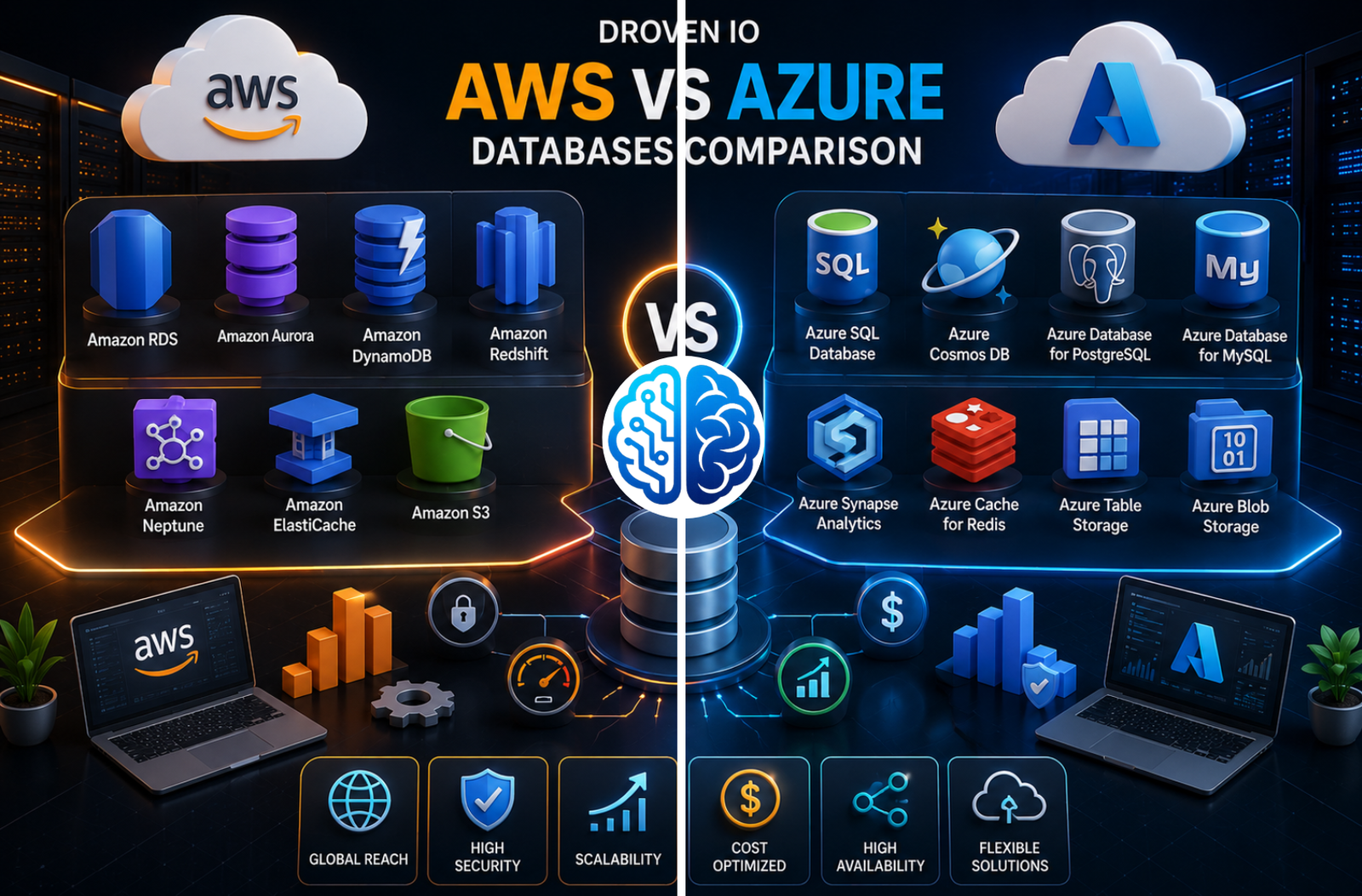
AWS and Azure both offer several database services.
AWS provides Amazon RDS, Aurora, DynamoDB, Redshift, ElastiCache, Neptune, and other database options. These cover relational databases, NoSQL, data warehousing, graph databases, and caching.
Azure provides Azure SQL Database, Cosmos DB, Azure Database for PostgreSQL, Azure Database for MySQL, Synapse Analytics, and Redis-based services.
If your business already uses Microsoft SQL Server, Azure may be easier to adopt. If your team wants more database variety and cloud-native flexibility, AWS is very strong.
The right database choice depends on your application type, data size, query pattern, performance needs, and budget.
Storage
Storage is one of the most common cloud needs. Businesses use cloud storage for files, backups, media, logs, app data, and archives.
AWS has Amazon S3, one of the most popular object storage services in the cloud industry. It is widely used for websites, app assets, backups, data lakes, and static file hosting.
Azure has Azure Blob Storage, which serves a similar purpose and works well inside Microsoft-based cloud environments.
Both platforms offer durable, scalable storage. The difference usually comes down to existing tools, pricing, region availability, and team experience.
Developer Experience
AWS is loved by many developers because it offers deep control and many services. Developers can build almost anything, from simple APIs to complex distributed systems.
The trade-off is complexity. AWS has many services, and choosing the right one requires experience.
Azure is also developer-friendly, especially for teams using .NET, Visual Studio, GitHub, Microsoft DevOps tools, and enterprise app frameworks.
If your development team works heavily with JavaScript, Python, Node.js, containers, serverless apps, or open-source tools, both platforms can work well. If your team works mostly with .NET and Microsoft tools, Azure may feel smoother.
Hybrid Cloud
Hybrid cloud means using both local infrastructure and cloud infrastructure together.
Azure is especially strong here because many traditional businesses already run Microsoft systems on-premises. Azure helps connect those systems with cloud services.
AWS also supports hybrid cloud, but Azure often feels more natural for companies with existing Microsoft-based IT infrastructure.
For businesses that cannot move everything to the cloud at once, hybrid cloud support can be a major deciding factor.
Global Reach
Both AWS and Azure have global infrastructure. They operate data centers across many regions and availability zones.
This matters because businesses can host apps closer to their users. A company serving customers in Asia, Europe, and North America can choose cloud regions that reduce delay and improve reliability.
Before choosing a platform, businesses should check which cloud provider has the best region support near their customers.
Support and Community
AWS has a huge developer community, strong documentation, many tutorials, and a large marketplace of third-party tools.
Azure also has strong documentation, Microsoft Learn, enterprise support, and deep integration with Microsoft’s partner network.
For beginners, community support matters a lot. If your team gets stuck, good documentation, forums, training materials, and support plans can save time.
AWS may have more cloud-native developer resources. Azure may have stronger enterprise and Microsoft-focused learning paths.
Best for Startups
Startups often choose AWS because it gives them flexibility, speed, and a wide range of cloud-native services. A startup can begin with simple hosting and later move into serverless computing, containers, AI, analytics, and global scaling.
AWS is also useful when a startup wants to experiment quickly. Developers can test ideas, deploy prototypes, and scale successful products.
Azure can also work well for startups, especially those building with Microsoft technologies. A startup using .NET, SQL Server, or enterprise software may find Azure practical.
For most cloud-native startups, AWS is often the more flexible choice. For Microsoft-based startups, Azure is a strong option.
Best for Enterprises
Enterprises often prefer Azure when they already use Microsoft products. Azure connects well with corporate identity, productivity tools, compliance systems, and enterprise software.
Large organizations may also choose Azure because their IT teams are already familiar with Microsoft management tools.
AWS is also excellent for enterprises, especially those building modern platforms, large-scale applications, analytics systems, and cloud-native products.
For enterprises, the decision usually depends on existing infrastructure. If the company is deeply Microsoft-based, Azure may reduce complexity. If the company wants broad cloud engineering flexibility, AWS is very competitive.
Migration
Migration means moving apps, databases, files, and systems from local servers or another cloud provider to a new cloud platform.
AWS provides many migration tools and services. Azure also provides strong migration support, especially for Windows Server, SQL Server, and Microsoft workloads.
Migration should not be rushed. A business should review its current systems, dependencies, security rules, downtime risks, and cost expectations before moving.
The best migration plan usually starts small. Move one workload, test performance, check costs, improve security, and then continue step by step.
Vendor Lock-In
Vendor lock-in happens when a business becomes too dependent on one cloud provider’s tools. Later, moving away becomes expensive or difficult.
Both AWS and Azure can create lock-in if a company uses too many provider-specific services.
This is not always bad. Managed services can save time and reduce maintenance. But businesses should understand the trade-off.
To reduce lock-in, companies can use containers, open-source databases, standard APIs, and portable architectures where possible.
Which Is Better?
There is no single winner for every business.
AWS is better if your business wants flexibility, a large service catalog, strong developer control, and cloud-native architecture.
Azure is better if your business already uses Microsoft tools, needs hybrid cloud, depends on Windows systems, or wants strong enterprise integration.
A small SaaS company may prefer AWS. A corporate office using Microsoft 365 and Active Directory may prefer Azure. An e-commerce store can use either. A bank or healthcare company may compare compliance, security, and support before deciding.
The best cloud platform is the one that fits your actual workload.
Simple Decision Guide
Select AWS if you want broad cloud services, strong developer flexibility, serverless options, scalable infrastructure, and a mature cloud-native ecosystem.
Choose Azure if you want Microsoft integration, enterprise identity management, hybrid cloud support, and smoother compatibility with Windows and Microsoft business tools.
Choose both only if your business has a strong reason for a multi-cloud strategy. Multi-cloud can improve flexibility, but it also increases complexity, cost management, monitoring work, and security planning.
PEOPLE ALSO READ : How to Cancel Game Mopfell78: A Simple Step-by-Step Guide for Users
Final Thoughts
The Droven IO AWS vs Azure comparison shows that both platforms are powerful, reliable, and suitable for modern businesses. AWS is often the better choice for flexibility, developer freedom, and cloud-native growth. Azure is often the better choice for Microsoft-based organizations, enterprise systems, and hybrid cloud needs.
Before choosing, look at your business honestly. What tools do you already use? What skills does your team have? What is your budget? Do you need AI, databases, storage, or global hosting? Are you building a startup product or managing an enterprise system?
Cloud computing is not just about choosing the most popular platform. It is about choosing the platform that helps your business work better, grow safely, and control costs over time.
For many businesses, AWS will be the right answer. For many others, Azure will be the smarter fit. The best decision is the one based on your real business needs, not hype.
Frequently Asked Questions
What is the main difference between AWS and Azure?
AWS focuses on cloud-native flexibility and a wide range of services, while Azure excels in Microsoft integration and enterprise environments.
Which platform is better for small businesses?
AWS is often preferred by startups and small businesses because of its extensive services and scalability, though Azure can also be a strong choice for Microsoft-based companies.
Is AWS cheaper than Azure?
Pricing depends on the services used, resource consumption, and licensing requirements. Both platforms offer pay-as-you-go pricing and cost-saving options.
Which cloud platform is better for artificial intelligence?
Both AWS and Azure provide powerful AI tools. AWS offers services like SageMaker, while Azure provides Azure AI and Azure OpenAI services.
Can a business use both AWS and Azure together?
Yes. Many organizations adopt a multi-cloud strategy and use both platforms to improve flexibility, performance, and business continuity.