
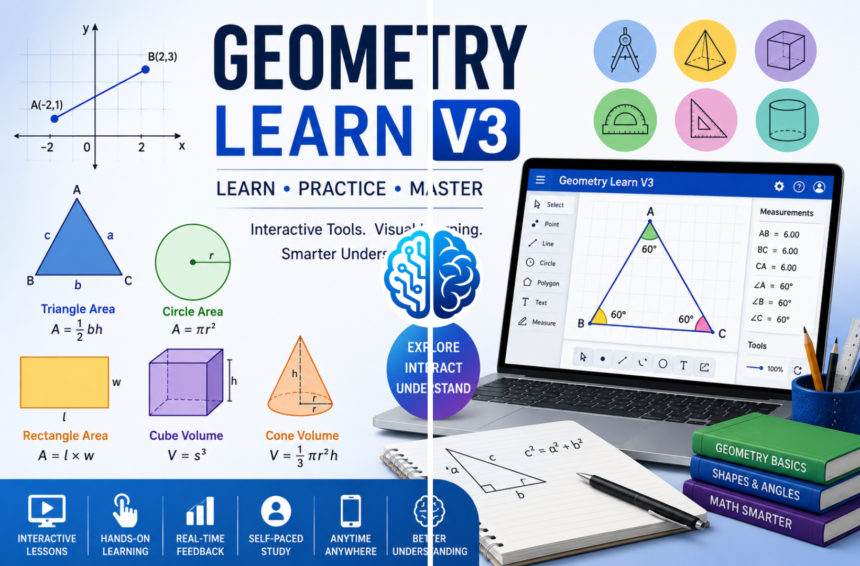
Geometry Learn V3 is a modern way to understand geometry through visual learning, interactive practice, and step-by-step concept building. Instead of treating geometry as a subject full of dry formulas, it focuses on helping learners see how shapes, angles, lines, and measurements actually work.
Geometry has always been one of the most visual parts of mathematics. A student may memorize the formula for the area of a triangle, but real understanding begins when they can see why that formula works. This is where interactive geometry learning becomes valuable. It gives learners the chance to move points, rotate figures, test angles, compare shapes, and observe changes in real time.
Geometry Learn V3 can be understood as a next-generation approach to learning geometry. It combines digital tools, guided lessons, visual explanations, practice exercises, and real-life examples. The goal is simple: make geometry easier to understand, easier to remember, and more useful in daily learning.
Quick Bio Table
| Information | Details |
|---|---|
| Topic Name | Geometry Learn V3 |
| Category | Mathematics Education |
| Learning Type | Interactive Geometry Learning |
| Primary Focus | Visual Understanding of Geometry |
| Suitable For | Students, Teachers, and Self-Learners |
| Skill Level | Beginner to Advanced |
| Main Subjects | Shapes, Angles, Lines, and Measurements |
| Learning Method | Interactive and Self-Paced |
| Key Benefit | Improved Geometry Understanding |
| Accessibility | Desktop, Tablet, and Mobile Devices |
| Educational Purpose | Strengthen Mathematical Thinking |
| Real-World Uses | Engineering, Architecture, Design, and Technology |
| Learning Outcome | Better Problem-Solving and Spatial Reasoning Skills |
What Geometry Learn V3 Means
Geometry Learn V3 is not just about reading geometry notes online. It is about learning geometry in a more active and practical way. The “V3” idea suggests an improved version of geometry learning where students are not passive readers. They become active learners.
In traditional classrooms, students often look at static diagrams in books. These diagrams are useful, but they do not always show what happens when a shape changes. Interactive learning allows students to drag, resize, rotate, and test geometric figures. This makes the learning process clearer and more engaging.
For example, when a student changes the sides of a triangle and sees that the angle sum remains 180 degrees, the concept becomes stronger. It is no longer just a rule written in a notebook. It becomes something the student has personally observed.
Why Geometry Matters
Geometry is more than a school subject. It helps people understand space, structure, size, design, direction, and measurement. It is used in architecture, engineering, construction, art, animation, game design, robotics, and many other fields.
A person designing a room needs geometry. A builder measuring walls uses geometry. A graphic designer working with shapes and spacing uses geometry. Even navigation and maps depend on geometric thinking.
This is why learning geometry properly matters. When students understand geometry deeply, they improve not only their math skills but also their problem-solving and visual reasoning skills.
The Role of Visual Learning
Geometry becomes easier when students can see ideas clearly. Visual learning helps turn abstract concepts into understandable pictures. Lines, angles, circles, triangles, and polygons are not just definitions; they become objects students can explore.
Research in mathematics education has long supported the importance of visualization and spatial reasoning. Good geometry learning encourages students to build mental images, draw models, and use diagrams to solve problems.
Geometry Learn V3 follows this same idea. It uses visuals to make difficult topics feel less confusing. A student who struggles with written explanations may understand the same concept quickly through a clear diagram or interactive model.
Interactive Geometry Learning
The main strength of Geometry Learn V3 is interactivity. Interactive learning means students do something with the lesson instead of only reading or watching.
They may move a point on a graph, adjust the radius of a circle, rotate a 3D shape, or test how changing one side affects the whole figure. This kind of learning keeps students involved.
When students interact with geometry, they are more likely to ask questions. They notice patterns, make predictions, and test ideas. This creates a stronger connection between the learner and the subject.
Learning Through Practice
Geometry is not mastered by reading alone. Practice is necessary. But practice should not feel random or mechanical. Good practice helps students understand why an answer is correct.
Geometry Learn V3 usually includes guided exercises, instant checking, and explanations. This helps students learn from their mistakes quickly. Instead of waiting for a teacher to mark work later, they can correct misunderstandings immediately.
This is especially helpful for topics like angle relationships, congruent triangles, similarity, coordinate geometry, area, surface area, and volume. These topics often require both calculation and visual understanding.
Better Understanding of Shapes
One major benefit of Geometry Learn V3 is that it helps students understand shapes more deeply. Many learners can identify a square or triangle, but they may struggle to explain properties clearly.
Interactive geometry learning allows students to compare shapes side by side. They can see how rectangles and squares are related, how different triangles behave, and how circles are built around radius and diameter.
This type of learning builds confidence. Students begin to understand not only what a shape is, but also how its parts work together.
Stronger Spatial Reasoning
Spatial reasoning is the ability to think about objects in space. It helps students imagine movement, position, size, and direction. Geometry is one of the best subjects for developing this skill.
Geometry Learn V3 supports spatial reasoning by allowing learners to rotate shapes, view 3D objects, and understand relationships between different parts of a figure.
This is useful beyond math class. Spatial reasoning is important in science, engineering, technology, design, and many practical tasks. A learner with strong spatial skills can understand diagrams, maps, layouts, and structures more easily.
Easier Formula Learning
Many students fear geometry because of formulas. Area, perimeter, circumference, volume, and surface area formulas can feel overwhelming when memorized without meaning.
Geometry Learn V3 makes formulas easier by connecting them to visuals. Instead of simply saying that the area of a rectangle is length multiplied by width, students can see rows and columns forming the total area.
When formulas are connected to meaning, they become easier to remember. Students are less likely to forget them because they understand where they come from.
Real-Time Feedback
One of the most useful benefits of interactive learning is real-time feedback. When a student answers a question, they can immediately see whether the answer is correct.
This quick response helps prevent repeated mistakes. If the student misunderstands a concept, they can review it right away. This makes the learning process smoother.
Real-time feedback also supports independent learning. Students can study at home without feeling completely stuck. They still need teachers and guidance, but they have more control over their own progress.
Self-Paced Learning
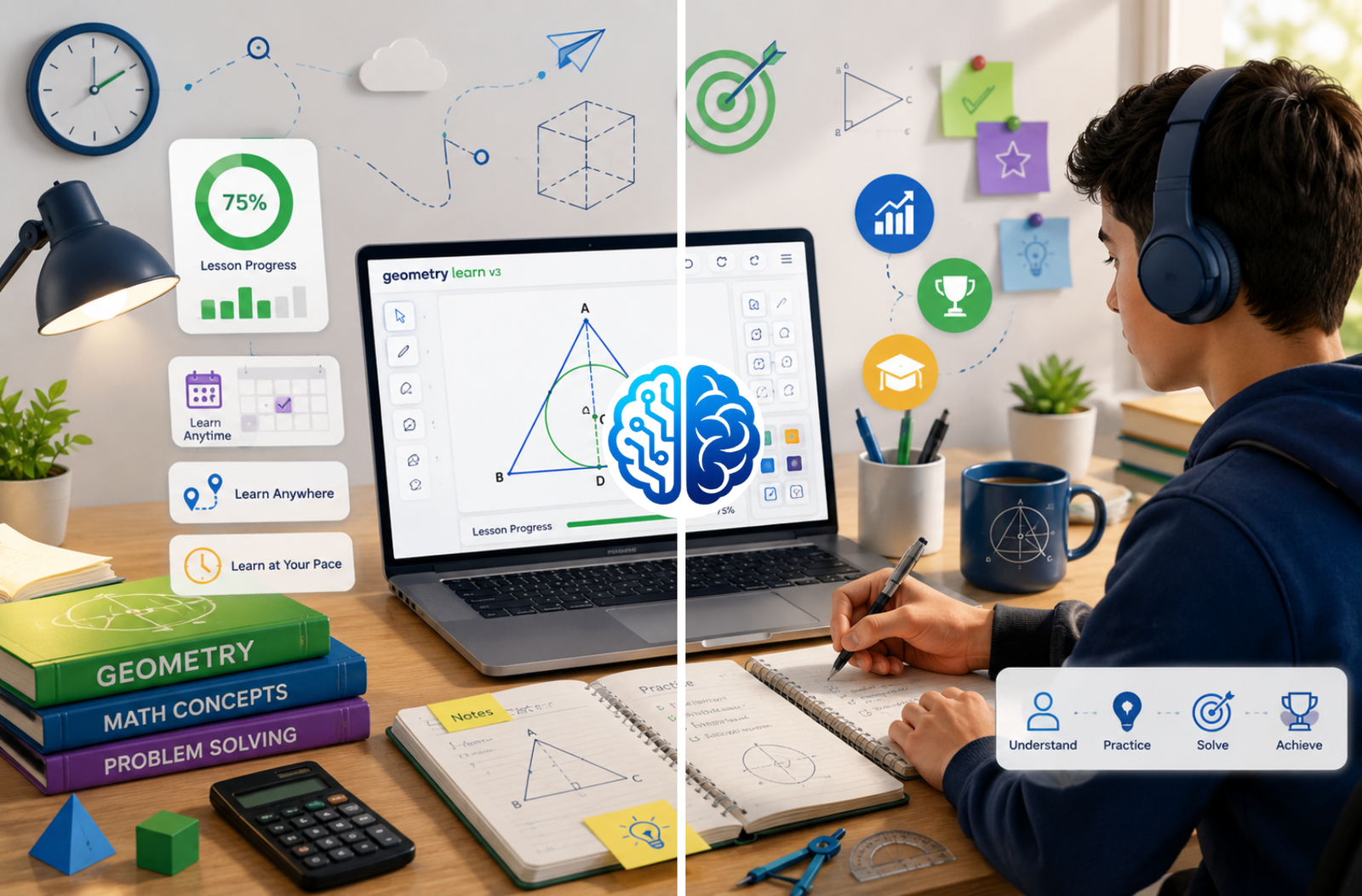
Every student learns differently. Some understand angles quickly but need more time with coordinate geometry. Others may be good at formulas but struggle with proofs.
Geometry Learn V3 supports self-paced learning. Students can repeat lessons, revisit examples, and practice weak areas without pressure. This is important because geometry requires a strong foundation.
When learners move at their own pace, they feel less rushed. This can reduce stress and improve understanding. A calm learner usually learns better than a learner who feels left behind.
Support for Teachers
Geometry Learn V3 is not only useful for students. It can also support teachers. Teachers can use interactive diagrams to explain difficult ideas in class.
For example, instead of drawing one triangle on the board, a teacher can show how different triangles change while some rules remain the same. This makes lessons more dynamic and easier to follow.
Teachers can also use digital practice tools to identify where students are struggling. If many students make mistakes in the same topic, the teacher can review that area again.
Help for Parents
Parents often want to help their children with math but may feel unsure about geometry. Interactive learning tools can make this easier.
When explanations are visual and step-by-step, parents can understand the topic along with the child. This creates a better learning environment at home.
Geometry Learn V3 can also help parents track progress. They can see which topics their child understands and which areas need more practice.
Useful for Beginners
Geometry Learn V3 is especially helpful for beginners. A beginner needs simple explanations, clear examples, and enough practice.
Starting with basic ideas like points, lines, angles, and shapes builds a strong foundation. Once these basics are clear, students can move toward more advanced topics such as triangle congruence, similarity, transformations, and coordinate geometry.
The best geometry learning does not rush. It builds understanding step by step.
Useful for Advanced Learners
Advanced learners can also benefit from Geometry Learn V3. They may use interactive tools to explore proofs, transformations, 3D geometry, and complex problem-solving.
For students preparing for exams, interactive learning can make revision more effective. It helps them recognize patterns and solve problems with better reasoning.
Advanced geometry is not only about solving quickly. It is about seeing relationships clearly. Interactive learning supports that deeper level of thinking.
Real-Life Applications
Geometry Learn V3 becomes more meaningful when connected to real life. Students should know why they are learning a topic.
Geometry appears in buildings, bridges, road designs, sports fields, packaging, furniture, mobile apps, and computer graphics. A designer uses spacing and symmetry. An engineer uses measurement and structure. A game developer uses shapes, angles, and movement.
When learners see these connections, geometry feels more useful. It becomes a skill, not just a school requirement.
Digital Tools and Geometry
Modern geometry learning often uses digital tools such as dynamic geometry software, graphing tools, videos, quizzes, and interactive worksheets.
Tools like GeoGebra show how powerful interactive math can be. Khan Academy also provides structured lessons and practice for many math topics, including geometry.
These tools prove that digital learning can support traditional teaching. They do not replace good teachers, but they make learning more flexible and visual.
Better Confidence
Many students say they are “bad at math” when the real problem is that they never learned the subject in a way that made sense to them.
Geometry Learn V3 can help rebuild confidence. When students finally see how a concept works, they begin to believe they can learn more.
Confidence matters in mathematics. A confident student is more willing to try, make mistakes, and improve. This mindset is essential for long-term success.
Common Geometry Topics
Geometry Learn V3 may cover many important topics, including points, lines, rays, angles, triangles, quadrilaterals, circles, polygons, coordinate geometry, transformations, area, perimeter, volume, and surface area.
It may also include proofs, congruence, similarity, symmetry, parallel lines, perpendicular lines, and 3D shapes.
A well-structured geometry course should move from simple ideas to complex ideas. Each topic should connect naturally to the next.
How Students Should Use It
To get the best results, students should not rush through lessons. They should watch, interact, practice, and review.
A good method is to learn one concept, try examples, solve practice questions, and then explain the idea in their own words. If they can explain it simply, they probably understand it well.
Students should also keep a small notebook for formulas, diagrams, and mistakes. Writing down mistakes is useful because it shows what needs improvement.
PEOPLE ALSO READ : Connectivity Issues HSSGamepad: Common Causes, Quick Fixes, and Troubleshooting Guide
Final Thoughts
Geometry Learn V3 represents a better and more practical way to learn geometry. It focuses on visual understanding, interaction, practice, feedback, and real-world use.
Geometry is not just about memorizing formulas. It is about understanding space, shapes, patterns, and relationships. When students learn geometry interactively, they can see the subject more clearly and remember concepts more naturally.
Students can find geometry less stressful, teachers can create more engaging lessons, and parents can offer better support at home.
In a world where education is becoming more digital and personalized, Geometry Learn V3 offers a helpful direction. It brings geometry closer to the learner and turns difficult ideas into clear, visual, and meaningful learning experiences.
Frequently Asked Questions
What is Geometry Learn V3?
Geometry Learn V3 is a modern approach to geometry education that uses interactive and visual learning methods to help students understand geometric concepts more effectively.
Is Geometry Learn V3 suitable for beginners?
Yes, it is designed for learners of all levels, including beginners who are just starting to study geometry.
What are the main benefits of Geometry Learn V3?
Its key benefits include visual learning, real-time feedback, self-paced study, improved problem-solving skills, and better concept retention.
Can Geometry Learn V3 help with exam preparation?
Yes, it helps students strengthen their understanding of geometry concepts, making exam preparation easier and more effective.
Does Geometry Learn V3 work on mobile devices?
Most modern geometry learning platforms inspired by this approach are accessible on computers, tablets, and smartphones.